<div class="page-header with-image bleed">
            <picture>
            <img src="https://surzyme.cn/wp-content/uploads/2026/10/1791967590-8cd51b88a2c9f19e72215155a060c94b.jpg" width="1920" height="400" class="feature-image wp-post-image" alt="" decoding="async" fetchpriority="high">
        </picture>
        <header class="post-header">
        <h1 class="post-title" style="">Phospholipase D (from Streptomyces) with high activity, high-temperature tolerance (up to 70°C), and strong stability.</h1>
        <div class="post-metas">
                            <span>Last updated on 2026-10-12</span>
                                    <a href="https://surzyme.cn/author/surzyme/">
                    <span class="meta-author">
                        <img alt='surzyme' src='https://weavatar.com/avatar/af42555338bd02899f2f4c80494cf4fc9a3a807f2521d66cbd4749b27b995a25?s=24&#038;d=mm&#038;r=g' srcset='https://weavatar.com/avatar/af42555338bd02899f2f4c80494cf4fc9a3a807f2521d66cbd4749b27b995a25?s=48&#038;d=mm&#038;r=g 2x' class='avatar avatar-24 photo avatar-small' height='24' width='24' loading='lazy' decoding='async'/>                        surzyme                    </span>
                </a>
                                <span>0 views</span>
                            </div>
    </header>
</div>

<p class="wp-block-paragraph">Phospholipase D (Phospholipases D; EC 3.1.4.4; PLD), also known as phosphatidylcholine hydrolase, belongs to the phospholipase family and is a class of hydrolases widely present in eukaryotes and certain bacteria.</p>


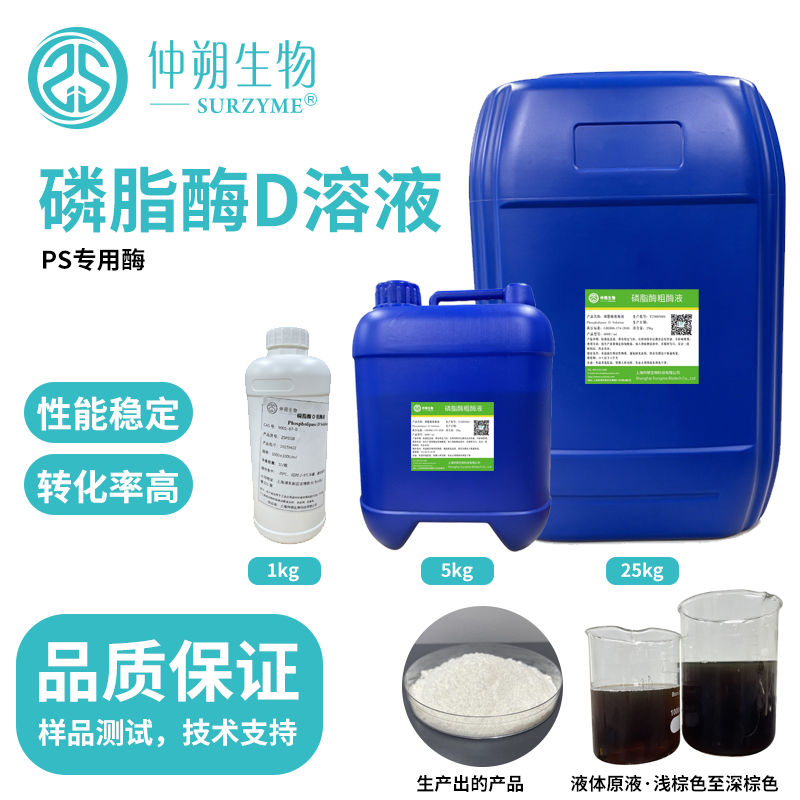
<p class="wp-block-paragraph">&nbsp; &nbsp; &nbsp; &nbsp; <strong>Phospholipase D (PLD)</strong> from Surzyme Biotechnology is a highly active, thermostable recombinant enzyme derived from <em>Streptomyces</em>.</p>


<p class="wp-block-paragraph">Its <strong>main functions</strong> are as follows:</p>


<p class="wp-block-paragraph">(1) It catalyzes cleavage of the phosphodiester bond in phospholipid molecules, generating phosphatidic acid (PA) and the corresponding polar head group (such as choline or ethanolamine). For example, it can catalyze hydrolysis of lecithin (PC) to produce choline and phosphatidic acid (PA), which can be used clinically for the detection of phospholipids (PLIP).</p>


<p class="wp-block-paragraph">(2) It possesses transphosphatidylation activity and can replace the head group of a phospholipid with other alcohols. A well-established application at present is that this phospholipase D can catalyze the synthesis of phosphatidylserine from the substrate L-serine and soybean lecithin, and is used industrially for the synthesis of phosphatidylserine grades PS50, PS70, and PS80.</p>


<ul class="wp-block-list">
<li>      Phospholipid + H<sub>2</sub>O ---- Choline + Phosphatidic acid</li>


<li>      Lecithin + L-serine —— Phosphatidylserine</li>
</ul>


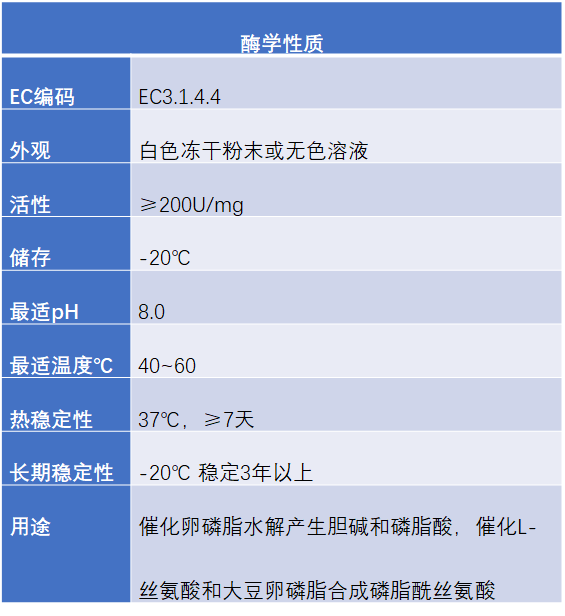
<p class="wp-block-paragraph"><strong>Enzymatic Properties:</strong></p>


<figure class="wp-block-image size-full"><img loading="lazy" decoding="async" width="565" height="616" src="https://surzyme.cn/wp-content/uploads/2026/10/1791773559-1740743950155010.png" alt="" class="wp-image-658" srcset=" https://surzyme.cn/wp-content/uploads/2026/10/1791773559-1740743950155010.png 565w, https://surzyme.cn/wp-content/uploads/2026/10/1791773561-1791773559-1740743950155010-275x300-1.png 275w" sizes="auto, (max-width: 565px) 100vw, 565px" / title="Phospholipase D (from Streptomyces) with high activity, high-temperature tolerance (up to 70°C), and strong stability."></figure>


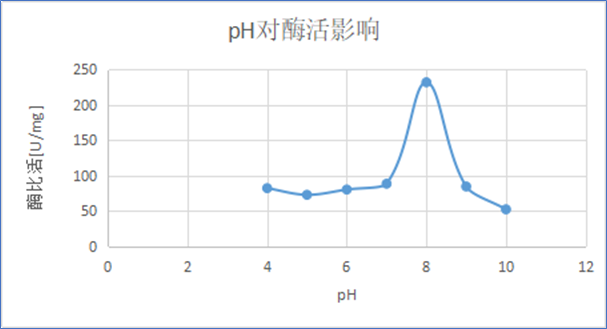
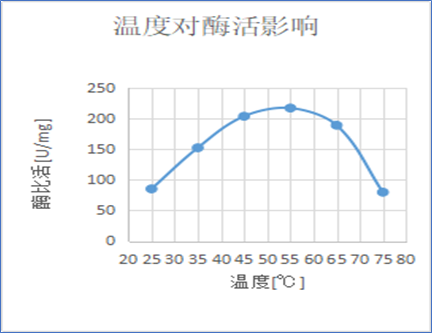
<p class="wp-block-paragraph"><strong>Research Data</strong></p>


<figure class="wp-block-image size-full is-resized"><img loading="lazy" decoding="async" width="607" height="329" src="https://surzyme.cn/wp-content/uploads/2026/10/1791773575-1740744123194277.png" alt="" class="wp-image-659" style="aspect-ratio:1.8283828382838283;width:554px;height:auto" srcset=" https://surzyme.cn/wp-content/uploads/2026/10/1791773575-1740744123194277.png 607w, https://surzyme.cn/wp-content/uploads/2026/10/1791773575-1740744123194277-300x163.png 300w" sizes="auto, (max-width: 607px) 100vw, 607px" / title="Phospholipase D (from Streptomyces) with high activity, high-temperature tolerance (up to 70°C), and strong stability."></figure>


<figure class="wp-block-image size-full"><img loading="lazy" decoding="async" width="432" height="333" src="https://surzyme.cn/wp-content/uploads/2026/10/1791773586-1740744314690401.png" alt="" class="wp-image-660" srcset=" https://surzyme.cn/wp-content/uploads/2026/10/1791773586-1740744314690401.png 432w, https://surzyme.cn/wp-content/uploads/2026/10/1791773586-1740744314690401-300x231.png 300w" sizes="auto, (max-width: 432px) 100vw, 432px" / title="Phospholipase D (from Streptomyces) with high activity, high-temperature tolerance (up to 70°C), and strong stability."></figure>


<p class="wp-block-paragraph">Product Advantages</p>


<p class="wp-block-paragraph">&nbsp; &nbsp; &nbsp; &nbsp;Surzyme Biotechnology has established a highly efficient phospholipase D expression system. Using targeted genetic engineering modification, we obtained stable, highly active phospholipase D molecules, effectively increasing enzyme yield. Combined with specialized separation and purification technology, we obtain enzymes of high purity and high activity that can be widely used in food processing, diagnostic reagents, biopharmaceuticals, and other industries.</p>