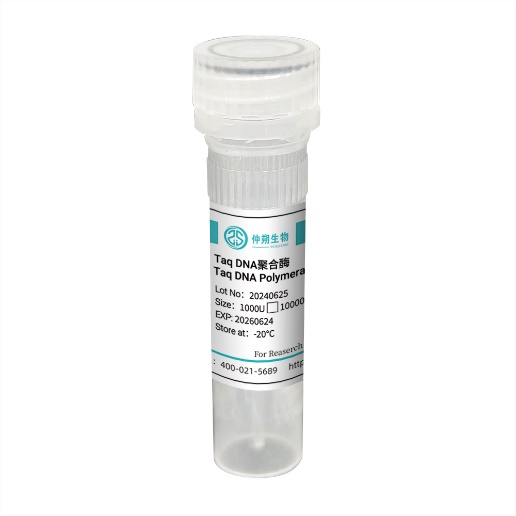
Taq DNA polymerase (Taq DNA Polymerase) is a highly efficient PCR DNA polymerase, derived from recombinant Escherichia coli cloned with the aquatic thermophilic bacterium (Thermus aquaticus) DNA polymerase gene. It has high thermostability and the same function as natural Taq DNA polymerase. The enzyme possesses 5’→3’ polymerase activity and double-strand-specific 5’→3’ exonuclease activity, high amplification efficiency, and good stability. It is commonly used for PCR amplification of DNA fragments, DNA labeling, primer extension, sequencing, and blunt-end A addition; the product can be directly used for T/A vector cloning. The enzyme has no 3′-5′ exonuclease activity.
Product Name; Taq DNA Polymerase(Taq DNA Polymerase)
Enzyme Commission number: EC 3.1.3.1
CAS Number: 9012-90-2
Source: Thermus aquaticus
Form : Solution (containing 50% glycerol)
Enzyme activity: 5U/μl
Purity: ≥95% (SDS-PAGE)
Unit definition: One active unit (U) is defined as the amount of enzyme required to polymerize 1.17 nmol of deoxynucleotides into double-stranded DNA in 8 min at 74 °C, using a synthetic hairpin oligonucleotide sequence as the template/primer.
Applications: Routine PCR identification; cloning of small target gene fragments; DNA 3'-end labeling; adding an "A" overhang to blunt-ended PCR products; T/A vector cloning.
suggestion
1) In each 50 µL reaction system, the optimal enzyme amount is 0.5-1 µL; too little enzyme may lead to low amplification efficiency!
2) Because PCR is extremely sensitive and can amplify the target gene sequence by more than 10 million-fold, when using Taq DNA polymerase, please be careful to avoid contamination by trace amounts of the DNA to be amplified, and where possible, consider setting up a no-template blank control to confirm whether there is contamination with the DNA to be amplified.
Storage conditions
Storage temperature: -25℃ to -10℃
Validity period: 24 months
 surzyme