
 surzyme
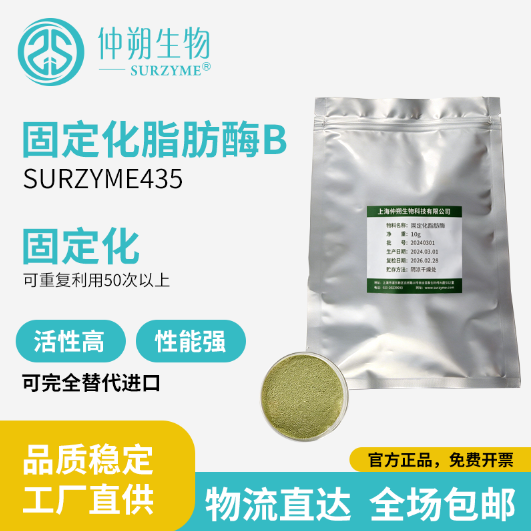
Zhongshuo Biotech Candida antarctica Lipase B (CALB for short) has genes derived from Candida antarctica. It is produced via large-scale fermentation of genetically recombinant Pichia pastoris. Immobilized CALB is prepared by immobilizing Lipase B (CALB) onto the surface of porous resin through physical and chemical methods. This lipase B can efficiently catalyze ester synthesis, ester hydrolysis, transesterification, ring-opening polymerization of lactones, ammonolysis, hydrolysis and synthesis of amides, addition reactions, etc. in aqueous or organic phases. Featuring high enantioselectivity and regioselectivity, it is widely used in oil processing, food, pharmaceutical, daily chemical and other industries.
I. Advantages of Immobilized CALB:
(1) Easy separation from the reaction system to avoid protein contamination.
(2) Higher stability. It can catalyze reactions normally at 60°C and exhibits good storage stability at room temperature.
(3) Higher enzyme activity and better performance in non-aqueous phases. Immobilization provides a favorable hydrophobic environment for the enzyme, thus boosting enzyme activity.
(4) Stronger enantioselectivity.
(5) Reusability. The enzyme can be easily recovered and reused in subsequent batches, lowering production costs.
(6) Immobilized enzyme is generally anhydrous, delivering higher catalytic efficiency for ester synthesis and other non-aqueous catalytic systems.
(7) Convenient storage and transportation; cold-chain transport is not required.
II. Product Parameters of Immobilized CALB:
| Activity | ≥10000 PLU/g |
| Reaction pH | 6–9 |
| Reaction Temperature | 20–60°C |
| Appearance | Pale yellow granules |
| Particle Size | 0.4±0.1 mm |
| Moisture Content (Loss on drying at 105°C) | 0.5%–5.0% |
| Immobilization Support | Porous resin |
| Reaction Solvent | Water, n-hexane, toluene, etc., or solvent-free |
Note: LU = Lipase Unit; PLU = Propyl Laurate Unit. 1 LU is defined as the amount of enzyme that hydrolyzes tributyrin to produce 1 μmol of titratable butyric acid per minute under specified conditions. 1 PLU refers to the amount of enzyme generating 1 μmol of propyl laurate per minute under specified conditions.
III. Types of Reactions Catalyzed by Immobilized CALB
(I) Ring-Opening Polymerization of Lactones
(II) Transesterification
(III) Ester Synthesis
(IV) Ester Hydrolysis
(V) Amide Synthesis
(VI) Addition Reaction
IV. Storage Conditions This immobilized enzyme granule can be stored at ambient temperature with a shelf life of two years.