
 surzyme
I. Product Introduction
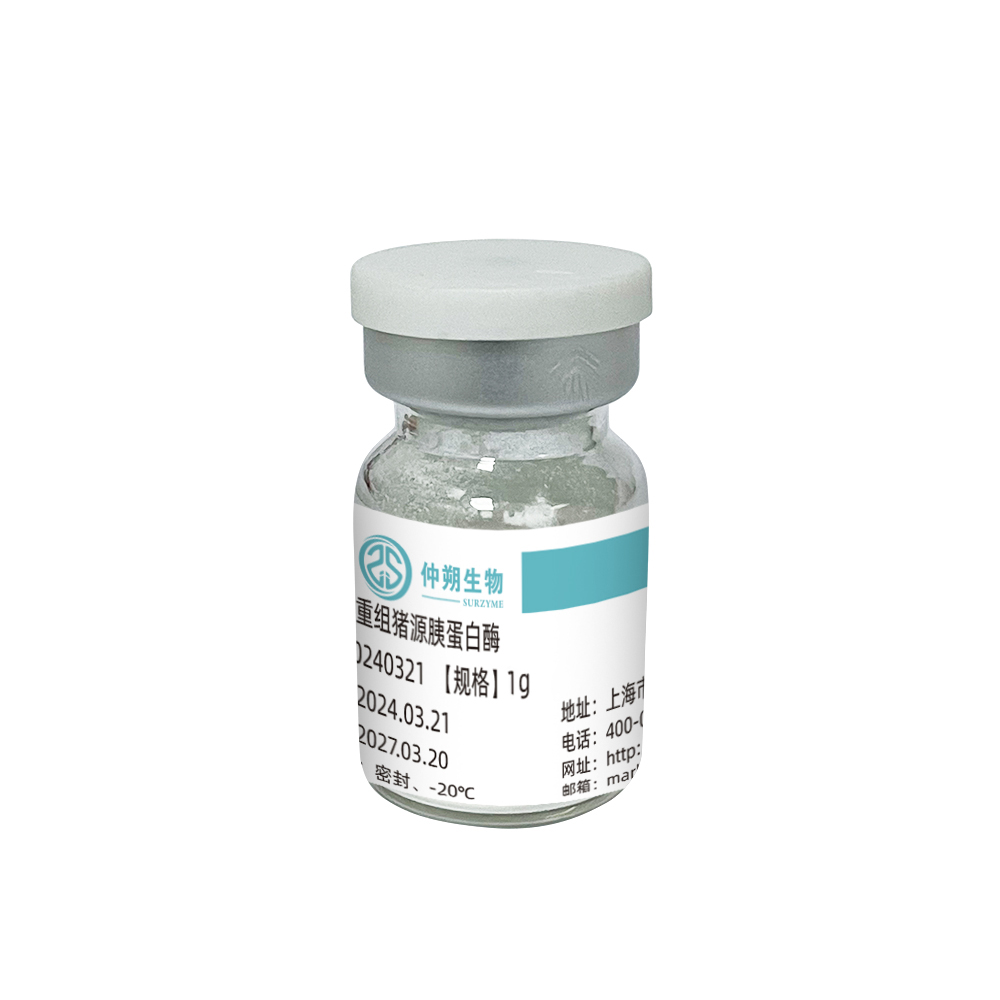
Recombinant Trypsin (EC 3.4.21.4) is a serine protease that specifically cleaves peptide bonds at the carboxyl terminus of arginine and lysine residues. This recombinant porcine trypsin is expressed in recombinant E. coli and purified by chromatography. Its amino acid sequence is identical to that of porcine pancreatic trypsin and exhibits the same enzymatic properties as animal-derived trypsin. It can replace porcine pancreatic trypsin in the development and manufacturing of various biotech products.
II. Product Properties
| Source | Recombinant E. coli |
| Appearance | Solution: colorless to pale yellow clear liquid; Lyophilized powder: white or off-white crystalline powder. |
| Specific Activity | ≥3800 U/mg pro. |
| Purity (HPLC) | β-Trypsin ≥70%, α-Trypsin ≤20% |
| Endotoxin Residue | <0.5 EU/60 U |
| Microbial Limit | <50 cfu/70 mg |
| Host Cell Protein Residue | ≤0.01% |
| Residual Host DNA | ≤10 ng/mg |
| Specificity | Cleavage of peptide bonds at carboxyl termini of arginine and lysine |
| Unit Definition | One USP trypsin unit is defined as the amount of enzyme that produces an absorbance increase of 0.003 at 253 nm per minute with a 1 cm light path, hydrolyzing BAEE at 25℃, pH 7.6. |
III. Applications
Manufacturing of recombinant insulin and its analogs; production of GLP‑1 and analogs; various cell culture applications including vaccine production and stem cell isolation; production of recombinant proteins and peptides; quality testing of protein and antibody drugs; protein structure and function research such as mass spectrometry, protein sequencing and peptide mapping; enzymatic synthesis of certain specialty compounds; manufacturing of other small proteins or peptides including cosmetic peptides, antimicrobial peptides and food flavor peptides.
IV. Usage Protocol
Optimal digestion time, dosage and temperature should be validated for different cell types. Taking 5 mL of 0.25% digestion solution for adherent Vero and BHK‑21 cells as an example: prewarm digestion solution to 25~30℃ at room temperature. Add to confluent monolayer cells and incubate for 7.5~10 min to dissociate cells into small clumps and single cells. Cell viability ≥93.0% for control group, EDTA-containing group and EDTA-free group. Subculture digested cells at a ratio of 1:3 into new culture flasks, and cell morphology remains normal when observed at 12 h and 24 h post seeding.
Notes: Activity is inhibited by serine protease inhibitors such as PMSF, and metal chelating agents such as EDTA. High concentrations of inorganic salts will also affect enzyme activity.
V. Storage Stability
Lyophilized powder is stable for 2 years at –20℃; digestion solution is stable for 1 year at –20℃.
VI. Product Advantages
Fully compliant with Chinese Pharmacopoeia 2020 standards
Animal-origin free: recombinantly produced, free of exogenous viral contaminants; no animal-derived raw materials used during production.
Consistent quality: mass production enables stable continuous batch supply; negligible batch-to-batch variation.
High purity: free of other proteases and non-specific cleavage; host protein and DNA residues meet pharmacopoeia requirements.
High yield: produced in ton-scale bioreactors with batch yield up to 150 g, suitable for industrial manufacturing customers.
Regulatory compliance: production equipment and facilities comply with relevant regulations. Manufacturing processes fully follow ISO 9001:2015 quality system and GMP guidelines.
Complete quality documentation: regulatory supporting documents available upon customer request.
Customization available: specifications can be tailored to customer requirements.
VII. Precautions and Disclaimer
This product is hygroscopic. Allow temperature equilibration to room temperature before opening.
For personal safety, wear lab coat and disposable gloves during handling.
This product must not be used for clinical diagnosis or therapy.