
 surzyme
Ultra Nuclease
Product Information
| Product Name | Product Code | Size |
| Ultra Nuclease | ZS0021ES25 | 25KU |
| ZS0021ES50 | 50KU | |
| ZS0021ES100 | 100KU |
Product Description
Ultra Nuclease (equivalent to Benzonase Nuclease), also known as broad-spectrum nuclease or non-restrictive endonuclease, is a genetically engineered endonuclease. It degrades all forms of DNA (single-stranded, double-stranded, linear and circular) and RNA without digesting proteins, featuring high substrate specificity. It can cleave and degrade various forms of DNA and RNA under a wide range of experimental conditions (6 M Urea, 0.1 M Guanidine HCl, 0.4% Triton X-100, 0.1% SDS, 1 mM EDTA, 1 mM PMSF). It is widely used for nucleic acid removal in bioproducts.
This enzyme is expressed and purified in Escherichia coli (E.coli) with purity ≥99%. The whole production process is completed in GMP workshop, and quality inspection is performed strictly complying with pharmacopoeia methods. It has no protease activity, is free of endotoxins and viral contaminants, and contains no protein tags. Regarded as the international gold standard, it is suitable for residual nucleic acid removal in industrial manufacturing of various bioproducts.
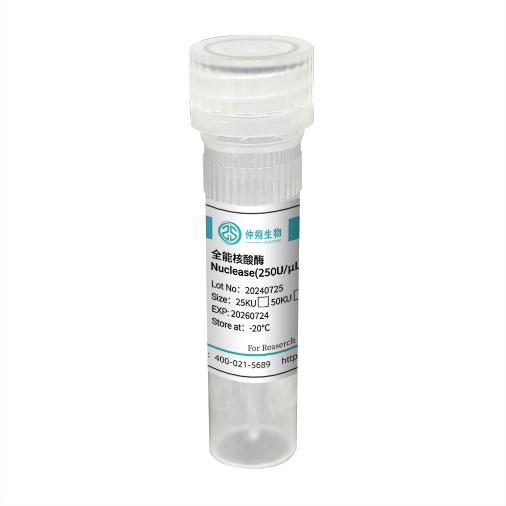
This product is supplied as a sterile liquid enzyme in storage buffer, appearing as a colorless and transparent solution.
Product Properties
| Source | E.coli |
| Molecular Weight | 26.0 kDa |
| Isoelectric Point | 6.2 |
| Purity | ≥90%, ≥99% |
| Enzyme Activity | 250–300 U/μL |
| Specific Activity | ≥1.5×10⁶ U/mg protein |
| Optimum pH | 8.0 (working range: 6.0–10.0) |
| Optimum Temperature | 37 ℃ (working temperature: 0–42 ℃) |
| Cofactor | 1–10 mM Mg2+ |
| Storage Buffer | 20 mM Tris-HCl (pH 8.0 at 25℃), 2 mM MgCl2, 50 mM NaCl, 50% Glycerol |
| Unit Definition | Under reaction conditions of 37 ℃ and pH 8.0, one unit is defined as the amount of enzyme required to reduce ΔA260 by 1.0 within 30 min in a 2.625 mL reaction system (equivalent to complete digestion of 37 μg salmon sperm DNA into oligonucleotides). |
Product Components
| Components | 25KU / 50KU / 100KU |
| Ultra Nuclease (250 U/μL) | 100 μL / 200 μL / 400 μL |
| 10×Buffer 2.0 | 100 μL / 200 μL / 400 μL |
Shipping and Storage
Shipped on dry ice. Store at -15 ℃ ~ -25 ℃; valid for 2 years.
Recommended Reaction Conditions
Ultra Nuclease maintains high stability and nucleic acid digestion activity under a broad range of conditions (6 M urea, 0.1 M Guanidine, 0.4% Triton X-100, 0.1% SDS, 1 mM EDTA, 1 mM PMSF). It is compatible with multiple cell lysis buffers (e.g. RIPA), and protein extraction reagents containing ionic & non-ionic detergents and reducing agents. Partial tolerable parameters are listed below.
| Parameter | Optimal Condition | Tolerable Working Range |
| Mg2+ | 1–2 mM | 1–10 mM |
| pH | 8.0–9.2 | 6–10 |
| Temperature | 37 ℃ | 0–42 ℃ |
| DTT | 0–100 mM | >100 mM |
| β-mercaptoethanol | 0–100 mM | >100 mM |
| Monovalent cations (Na+, K+) | 0–20 mM | 0–150 mM |
| PO43- | 0–10 mM | 0–100 mM |
Note: Optimal conditions refer to reaction conditions retaining over 90% of Ultra Nuclease activity; tolerable working conditions refer to reaction conditions retaining over 15% enzyme activity.
Applications
1) During recombinant protein purification or protein extraction from tissue/cell samples, Ultra Nuclease removes nucleic acid contamination and effectively reduces sample viscosity to facilitate downstream processing.
2) Addition of Ultra Nuclease into cell or bacterial lysate removes nucleic acids in crude extracts, lowers solution viscosity and thereby increases protein yield.
3) Reduce aggregation of preserved peripheral blood mononuclear cells (PBMC).
4) Efficiently eliminate interference from negatively charged nucleic acids on protein samples for 2D SDS-PAGE, improve protein separation and enhance resolution of two-dimensional electrophoresis.
5) Remove DNA contamination during protein-based vaccine and viral sample preparation.
Notes for Use:
Crude samples containing abundant proteins, cell wall debris and other salts may partially inhibit enzyme activity. Increase enzyme dosage when applying to such samples.