
 surzyme
1. Product Information
| Product Name | Product Code | Size |
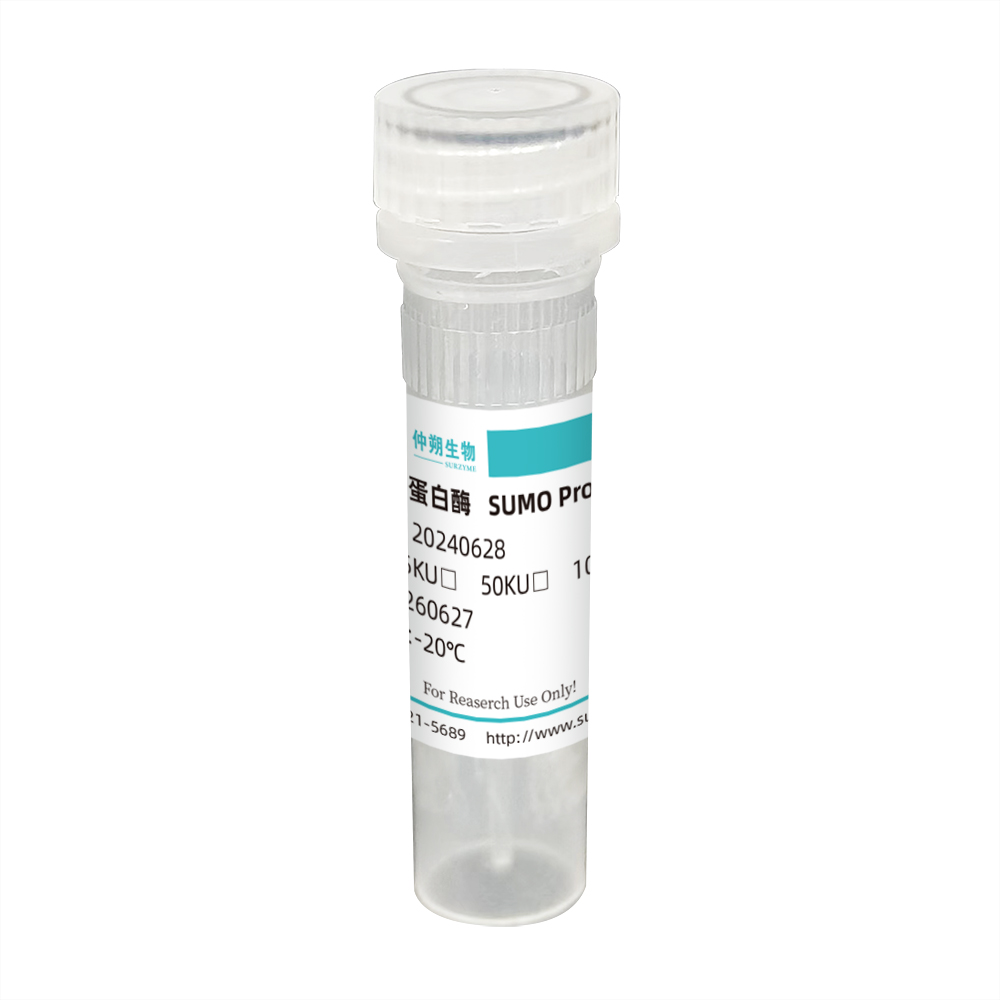
| SUMO Protease | ZS00021ES25 | 25KU |
| ZS0002ES50 | 50KU | |
| ZS0002ES100 | 100KU |
2. Product Description
SUMO Protease (also known as Ulp) is a recombinant fragment of ULP1 (Ubl-specific protease 1) from Saccharomyces cerevisiae. It possesses high specificity toward SUMO protein fusions and recognizes the tertiary structure of SUMO rather than amino acid sequences. SUMO Protease identifies the full-length 100-amino-acid SUMO (Small Ubiquitin-like Modifier) tag protein and efficiently cleaves SUMO off from the fusion protein. Compared with recognition sites of proteases such as EK and TEV, SUMO Protease exhibits extremely high cleavage specificity owing to its long recognition sequence. It retains high activity across a broad range of reaction conditions, including temperature (4–30℃) and pH (5.5–9.5). SUMO Protease carries a poly-His tag, which facilitates removal of SUMO Protease via affinity chromatography and purification of target protein.
3. Product Properties
| Source | E.coli |
| Molecular Weight | 26.55 kDa |
| Purity | ≥90%, ≥95% |
| Enzyme Activity | 200–250 U/μL |
| Specific Activity | ≥1.5×10⁶ U/mg protein |
| Storage Buffer | 500 mM Tris-HCl, pH 8.0, 2% Igepal (NP-40), 1.5 M NaCl, 10 mM DTT |
| Unit Definition | One unit (1 U) is defined as the amount of SUMO Protease required to achieve ≥85% cleavage efficiency of 2 μg fusion protein containing the cleavage site after 1 hour incubation at 30℃. |
4. Usage Protocol
4.1. Prepare the recommended reaction system in an EP tube
Component Volume
Fusion protein 20 μg
10× SUMO Protease Buffer 20 μL
ddH2O to 190 μL
SUMO Protease 10 μL
Total volume 200 μL
4.2. Incubate at 30℃. Transfer 30 μL aliquots of the reaction mixture into separate EP tubes at 0.5, 1, 2 and 3 hours.
4.3. Add 30 μL of 2×SDS Loading Buffer to each EP tube and store at -20℃.
4.4. After all samples are collected, boil samples for 5 min and take aliquots for SDS-PAGE analysis to determine the optimal incubation time.
【Note】If the fusion protein requires low-temperature treatment, incubate the reaction mixture overnight at 4℃ and increase SUMO Protease dosage to guarantee cleavage efficiency.
4.5. To remove SUMO Protease after digestion, use His-tag purification resin for affinity chromatography.
5. Storage Conditions
Long-term storage: -80℃; after thawing, store at -20℃.
6. Product Advantages
Animal-origin free: Recombinantly produced, free of exogenous viral contaminants; no animal-derived raw materials used during production.
Stable quality: Mass production enables consistent continuous batch supply; negligible batch-to-batch variation and stable quality.
High purity: High specific activity; host protein residual level below bioproduct specification limits.
Notes:
1. For optimal cleavage performance, the recombinant protein should be partially or fully purified;
2. For most fusion proteins, the optimal NaCl concentration in reaction buffer is 150 mM. However, NaCl concentration can be adjusted between 100 mM and 300 mM according to practical needs to achieve best results. Take the salt concentration from the fusion protein sample into consideration in experiments;
3. Imidazole concentration should be kept below 150 mM; higher concentrations will inhibit SUMO Protease activity.
This product is for research use only. Not for pharmaceutical, clinical therapeutic, food or cosmetic applications.