
 surzyme
1. Product Introduction
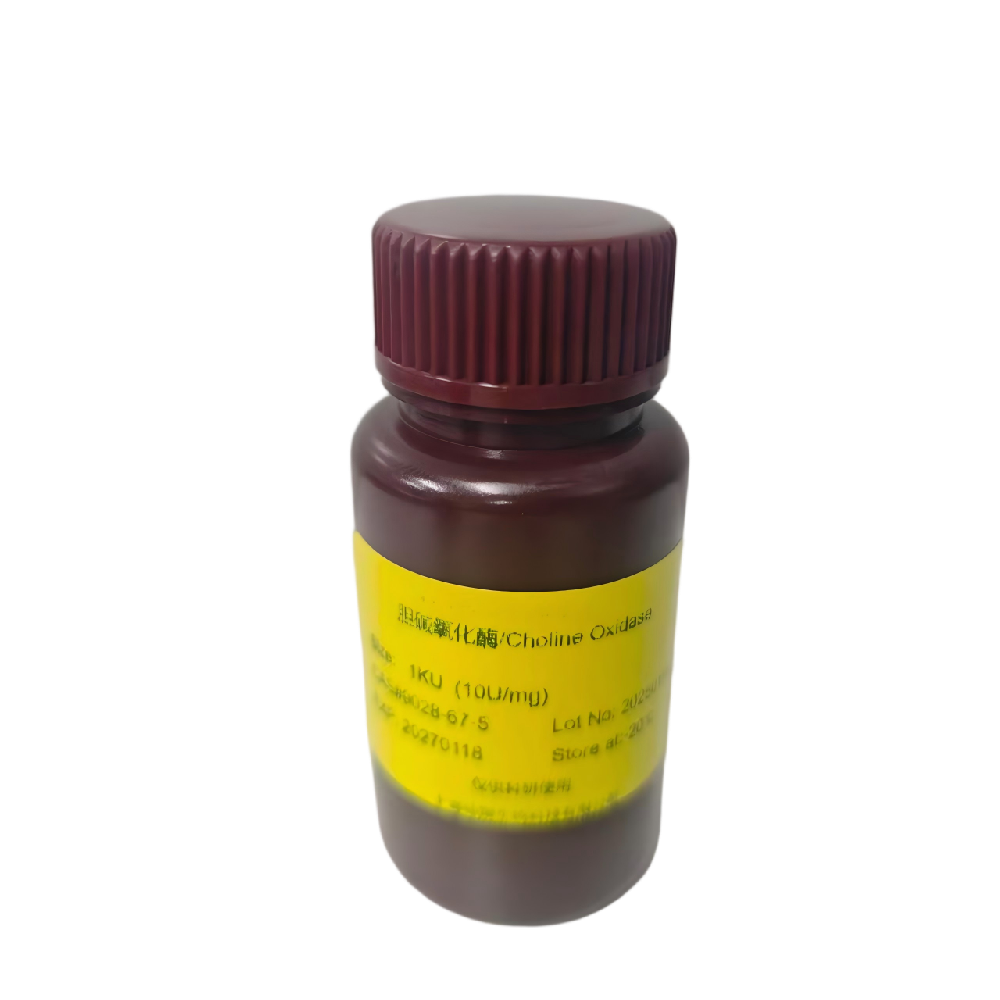
The gene encoding Zhongshuo Bio choline oxidase (Choline Oxidase, EC 1.1.3.17, CAS: 9028-67-5) is derived from Arthrobacter globiformis, and the enzyme is produced by heterologous expression and purification using an E. coli recombinant expression system.
Unlike conventional commercially available choline oxidase, which rapidly loses activity at high temperatures, this product has undergone directed evolution and optimization of fermentation and purification processes, maintaining high-level catalytic activity over the range of 37–55℃ (optimal temperature approximately 50℃). After incubation at 37℃ for 120 min, residual enzyme activity remains >99%, and the suitable pH range is 7.0–8.5. The product is particularly suitable for applications such as clinical diagnostic kits, choline/phospholipid detection reagents, amperometric biosensors, and research reagents.
II. Core Advantages
• High activity across a wide temperature range: maintains >95% of maximum enzyme activity at 37–55°C, reaches peak activity at 50°C, covering needs across multiple scenarios from room temperature to medium-high temperatures.
• Excellent thermal stability: after incubation at 37°C for 120 minutes, residual enzyme activity >99%, so long-duration reaction systems do not require frequent enzyme supplementation.
• High specific activity: enzyme specific activity ≥10 U/mg (lyophilized powder), purity ≥90% by SDS-PAGE, low levels of contaminating enzymes.
• High specificity: highly specific for choline, with almost no cross-activity with similar compounds (ethanolamines, alcohols, etc.).
• Wide stable pH range: specific activity/maximum specific activity >0.9 at pH 7.0–8.5, compatible with multiple buffer systems.
III. Technical Specifications
| Item | Specifications/Characteristics |
| Enzyme Name | 胆碱氧化酶(Choline Oxidase, COD) |
| EC Number | 1.1.3.17(choline:oxygen 1-oxidoreductase) |
| CAS Number | 9028-67-5 |
| Gene Source | 球形节杆菌 Arthrobacter globiformis |
| Expression System | 大肠杆菌(Escherichia coli)Recombinant Expression |
| Enzyme Classification | GMC oxidoreductase superfamily / Flavoprotein (covalently bound FAD) |
| Product Form | Lyophilized powder |
| Enzyme Activity Definition | One unit (U) is defined as the amount of enzyme required to produce 1 μmol of H₂O₂ per minute at 37°C and pH 8.0. |
| Specific Activity | ≥ 10 U/mg |
| Purity | ≥ 90% SDS-PAGE |
| Storage Conditions | Store at -20°C in a dry place, protected from light; shelf life of over 12 months. |
IV. Enzymatic Properties Profile
4.1 Enzyme specific activity vs. temperature curve
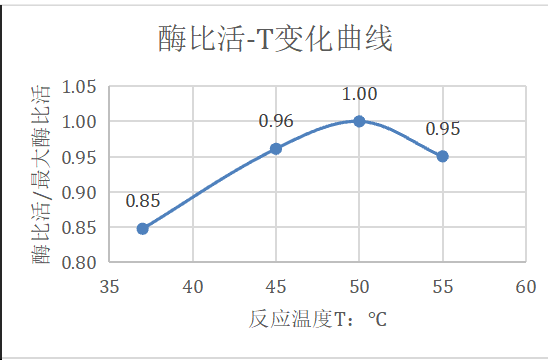
Data note: Changes in enzyme specific activity were measured over the temperature range of 37–55°C. The results showed that the enzyme reached maximum enzyme activity at 50°C (with maximum enzyme specific activity set as 1), 0.96 at 45°C, 0.95 at 55°C, and 0.85 at 37°C, indicating that this product has excellent broad-temperature-range activity characteristics.
4.2 37℃Thermal stability curve
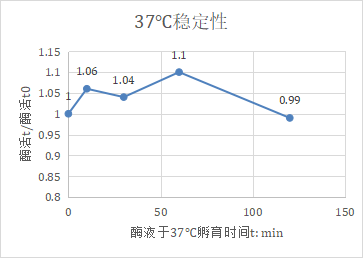
Data description: The enzyme was incubated at 37°C for 0, 10, 30, 60, and 120 minutes, respectively, and then residual enzyme activity was measured. The results showed that after 120 minutes, the enzyme activity ratio still reached 0.99 (>99%), indicating that the enzyme has excellent long-term operational stability at 37°C and is suitable for use in clinical diagnosis and long-duration detection reactions.
4.3 Enzymespecific activity versus pHcurve
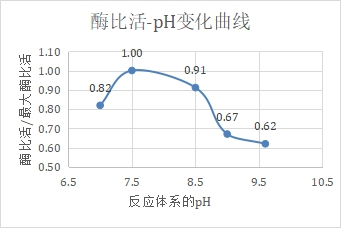
According to the description: Relative enzyme activity was measured in Tris buffer systems at different pH values. The optimal pH is 7.5 (with the maximum specific enzyme activity recorded as 1); pH 7.0 is 0.82, pH 8.5 is 0.91, pH 9.0 is 0.67, and pH 9.5 is 0.62. The enzyme maintains good activity in the neutral to weakly alkaline range (pH 7.0–8.5).
V. Application Scenarios
| Application Areas | Industry Pain Points | Product Value |
| Clinical Biochemical Diagnostics (Choline/Phospholipid/Lecithin Detection) | Traditional methods suffer from low sensitivity and poor specificity; H₂O₂-coupled colorimetry requires highly efficient and stable COD | High specific activity + high specificity + broad-temperature stability; Significantly improves assay kit sensitivity and batch-to-batch consistency |
| Sphingomyelin/Phosphatidylcholine Assay | Requires precise quantification of choline released by phospholipase D; instability of COD leads to signal drift | 99% enzyme activity retained after 120 min at 37°C; Ensures accurate and reliable results for long-duration reactions |
| Amperometric Biosensors (Choline electrodes / Modified blood glucose meters) | Enzyme coatings easily lose activity, limiting sensor lifespan; conventional COD enzymes degrade rapidly at room temperature. | High activity across a wide temperature range + excellent operational stability; extends sensor lifespan and improves the signal-to-noise ratio. |
| Flow Injection Analysis (FIA) / Microfluidic Chip-based Detection | Online detection requires enzymes to withstand continuous flow and temperature fluctuations; conventional products often exhibit significant batch-to-batch variation. | Consistent and controllable batch quality; Compatible with automated, high-throughput detection platforms. |
| Choline Detection in Food/Dairy Products | Complex matrices (e.g., milk) contain numerous interfering substances; high specificity is required to avoid false positives. | High substrate specificity and minimal cross-reactivity; Accurate quantification even in complex sample matrices. |
6. Ordering Information
| Product Name | Specification | Catalog Number |
| 胆碱氧化酶(Choline Oxidase) | 100 U | ZSE9037-1 |
| 胆碱氧化酶(Choline Oxidase) | 500 U | ZSE9037-2 |
| 胆碱氧化酶(Choline Oxidase) | 1000 U | ZSE9037-3 |
| 胆碱氧化酶(Choline Oxidase) | Custom Specification (Please contact sales) | ZSE9037-C |
7. Precautions
• This product is a lyophilized powder formulation. Store at -20°C in a dry, light-protected place and avoid repeated freeze-thaw cycles.
• Before use, dissolve and dilute with an appropriate buffer (recommended: 10 mM Tris-HCl, pH 8.0, containing 2 mM EDTA and 1% KCl).
• Metal ions such as Fe³⁺, Zn²⁺, and Co²⁺ strongly inhibit this product (at 5 mM concentration), so please avoid them when preparing the reaction system.
• For research and in vitro diagnostic (IVD) raw material use only. Not for use in human or animal in vivo experiments.
8. Contact Information

Shanghai Zhongshuo Biotechnology Co., Ltd.
Address: Room 502, 5th Floor, Building A, No. 858 Yunqiao Road, Pudong New Area, Shanghai
Tel: 400-021-5689, 021-20239093
Website: www.surzyme.com Email: sales@surzyme.com